Why You Are Always Broke: 7 Money Patterns Keeping You Stuck (2026)
A data-driven look at why money keeps disappearing, with real statistics, everyday examples, and a practical system to break the cycle.
Why feeling broke is often a systems problem, not a character flaw
If you keep asking why you are always broke, the answer is usually not that you are lazy, irresponsible, or bad at math. More often, your money system is too weak for the speed of real life.
Money leaves in fragments. Rent goes out once, but food, rides, subscriptions, snacks, coffee, late-night delivery, and quick online purchases go out all month. If you only notice the large payments, the smaller pattern keeps winning.
That is why so many people feel like they work hard and still end up short before month-end. The problem is often not one dramatic mistake. It is a repeated set of habits that stays invisible until the account balance feels tight.
This article breaks down the most common reasons people stay stuck, using real data and practical examples. If any of this feels familiar, that is good news. Patterns can be changed once you can actually see them.
The numbers behind the "always broke" feeling
A few current statistics show why this problem is so common.
- The U.S. Bureau of Labor Statistics reported average annual household spending of $78,535 in 2024, or roughly $6,545 per month.
- In the same 2024 BLS release, housing was 33.4% of household spending and transportation was 17.0%, meaning those two categories alone consumed just over half of the average budget.
- BLS also reported that food represented 12.9% of spending in 2024, or $10,169 per year on average.
- The Federal Reserve's 2024 SHED report found that 37% of adults said spending increased, while only 32% said income increased over the same period.
- The same Federal Reserve report found that 60% of adults said price changes made their finances worse, 29% had income that varied at least occasionally month to month, and 11% said income variability caused difficulty paying bills.
- In the Fed's emergency-expense data for 2024, 63% of adults said they could cover a $400 emergency expense with cash or the equivalent. That still leaves a large minority without a strong cushion.
These numbers matter because they show three things at once: fixed costs are heavy, everyday categories are still meaningful, and many households are operating with less margin than they would like.
Why most people stay broke even when they earn enough to improve
The most frustrating version of this problem is not "I have no income." It is "I make money, but I never feel ahead."
That usually happens when spending grows quietly to match income. A raise comes in, but so do better takeout habits, more app subscriptions, more taxis, more impulse convenience spending, and less attention to category limits.
The Federal Reserve's 2024 data supports that feeling. A larger share of adults said spending rose than said income rose. In plain language: for many households, money pressure did not come from income standing still alone. It came from expenses climbing faster.
That is why learning how to track expenses matters before trying more advanced budgeting rules. You cannot fix what you cannot see.
7 money patterns that keep people stuck
1. You only track the big bills
Most people remember rent, loan payments, and salary. They do not remember the dozens of medium and small outflows around them.
Real example for one week:
- Groceries: $118
- Coffee and snacks: $36
- Two taxi rides: $28
- Lunches out: $54
- Streaming and app renewals: $22
- Delivery fee and tip: $18
None of these numbers looks destructive alone. Together, they are $276 in one week. Over four weeks, that becomes $1,104.
This is one of the biggest answers to "where my money goes every month." It usually does not vanish. It leaks.
2. Your fixed costs are too heavy for your income
Sometimes the issue is not overspending on fun. It is that your basic structure is expensive.
BLS data shows housing took 33.4% of average household spending in 2024 and transportation took 17.0%. If your rent, commute, car payment, fuel, and parking are already eating most of your income, you can feel broke even when your discretionary spending is moderate.
Real example:
Net monthly income: $3,200
- Rent: $1,250
- Utilities and internet: $220
- Car payment: $310
- Insurance: $140
- Fuel and transport: $190
- Groceries: $420
Before eating out, buying clothes, paying for subscriptions, or saving anything, you are already at $2,530. That leaves $670 for everything else.
In this situation, a few convenience habits can wipe out the month fast.
3. You spend by mood, not by category
When money decisions happen emotionally, categories blur.
A stressful day becomes delivery. A busy day becomes a taxi. A boring evening becomes online shopping. None of this means you are reckless. It means spending is quietly doing emotional work.
The problem is that emotional spending often hides inside ordinary categories. "Food" can contain groceries, restaurant meals, coffee runs, and late-night delivery. Those are very different behaviors.
That is why category detail matters. If everything is labeled "food," you miss the real pattern.
4. Your income is not stable enough for a fixed-plan budget
The Federal Reserve reported that 29% of adults had income that varied at least occasionally from month to month in 2024. Among self-employed adults, that number was even higher.
If your income changes, a rigid monthly plan can fail even when your average income is decent.
Real example:
Freelancer average income over three months:
- January: $3,900
- February: $2,450
- March: $4,300
Average monthly income looks like $3,550, but that number does not help much in February.
If the budget is built as though every month equals the average, then low months feel like personal failure when they are really a planning mismatch.
The fix is to budget from a lower baseline and treat higher-income months as buffer-building months.
5. You confuse wants with recurring defaults
People often think lifestyle creep has to look flashy. It usually looks ordinary.
Examples:
- keeping four subscriptions you barely use
- ordering food because it is easier, not because it is special
- buying convenience every week instead of occasionally
- using taxis as a default instead of as an exception
The 50/30/20 framework can help here, but only if you classify honestly. If you need a refresher, this 50/30/20 guide shows how to separate real needs from comfort spending without turning budgeting into punishment.
6. You never review the month while it is still happening
A lot of people check their money only after the damage is done.
That creates a familiar loop:
- spend normally
- notice balance is low
- feel bad
- promise to do better next month
- repeat
A weekly review breaks that cycle.
Even ten minutes is enough to answer:
- Which category is running hot?
- What repeated more often than expected?
- Is this month expensive because of one event or because of daily drift?
Without review, money management becomes memory. Memory is not reliable enough.
7. You do not have a visible buffer
Being broke is not always about low income. Sometimes it is about having no shock absorber.
The Federal Reserve found that 63% of adults could cover a $400 emergency expense with cash or the equivalent in 2024. That still means many people would need to borrow, carry a balance, or miss something else.
Without a buffer, small disruptions become full-budget problems:
- medicine
- tire repair
- birthday gift
- school expense
- appliance replacement
When every surprise has to come from this month's cash flow, you feel financially fragile even in an ordinary month.
What this looks like in real life
Take a realistic monthly example.
Net income: $3,400
Core bills:
- Rent: $1,200
- Utilities and internet: $210
- Transport: $220
- Groceries: $430
- Insurance: $110
- Phone: $50
Core total: $2,220
Now add the less visible layer:
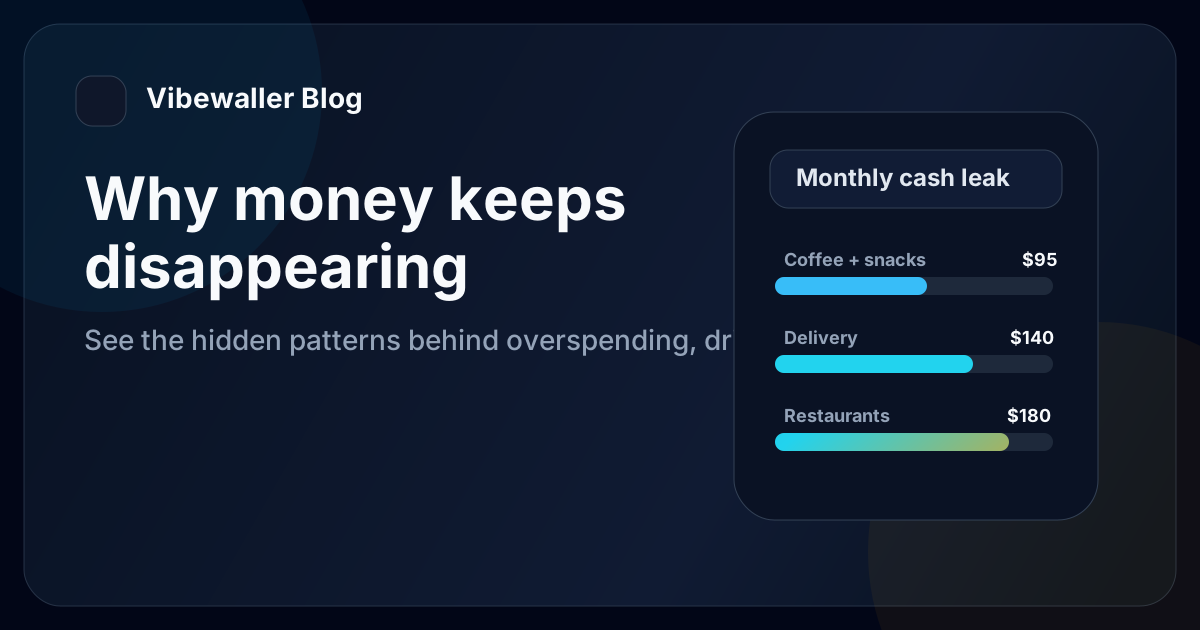
- Coffee and snacks: $95
- Delivery: $140
- Restaurants: $180
- Streaming and apps: $48
- Taxis: $72
- Small online shopping: $135
- Weekend impulse spending: $160
Convenience total: $830
That leaves $350.
Then one real-life issue hits:
- pharmacy and doctor visit: $90
- birthday gift: $60
- household item replacement: $75
Now the remaining margin is $125.
Nothing here is wild. That is the point. Most "always broke" months are not disasters. They are normal months with no buffer and too many invisible defaults.
What to do instead
You do not need a perfect financial life. You need a money system strong enough to survive ordinary behavior.
Step 1: Track every outflow for 30 days
Capture:
- amount
- category
- account or card
Keep categories simple:
- housing
- groceries
- transport
- eating out
- subscriptions
- shopping
- health
- fun
- savings
Step 2: Split fixed costs from flexible spending
This helps you answer the most useful question: am I squeezed by structure or by habits?
If fixed costs are the issue, the solution is structural. If flexible categories are the issue, the solution is behavioral.
Step 3: Review weekly, not just monthly
A weekly review catches patterns before they become regret.
Step 4: Put one buffer transfer on autopilot
Even a small recurring transfer matters. The goal is not to look impressive. The goal is to make the next surprise less disruptive.
Step 5: Use a system that makes the next entry easy
If logging a transaction feels harder than the transaction itself, consistency dies.
That is why tools matter. If you want to actually see where your money goes, tools like Vibewaller help automate this in seconds. You still need the habit, but the system becomes much easier to maintain.
FAQ
Why am I always broke even when I have a job?
Usually because spending is spread across fixed costs, convenience habits, and irregular expenses that are not visible enough in the moment. Income alone does not create control. Visibility does.
Is being broke always a budgeting problem?
No. Sometimes the issue is genuinely low income or high fixed costs. But even then, tracking clearly helps you distinguish structural pressure from avoidable spending drift.
What is the fastest way to stop feeling broke?
Track all spending for one month, separate fixed and flexible categories, and review once a week. That gives you a usable picture faster than trying to follow a complex budget from day one.
Should I use Excel or an app?
Excel works for disciplined users. An app is usually better when speed and consistency matter. The best tool is the one you will still use next month.
How can Vibewaller help without making budgeting feel heavy?
Vibewaller helps you capture transactions quickly, keep categories consistent, and see assets, spending, and limits in one flow. The goal is not more admin. It is better visibility.
Conclusion
If you keep wondering why you are always broke, try replacing judgment with diagnosis.
Look at the structure. Look at the invisible habits. Look at the recurring categories. Look at whether your income is stable enough for the plan you are trying to use.
Once the pattern is visible, the problem gets smaller.
If you want to make that visibility easier, return to the main page, read the guide on how to track expenses, review the 50/30/20 budget rule, or start using Vibewaller and turn money tracking into something you can actually keep up with.
Sources
- U.S. Bureau of Labor Statistics, Consumer Expenditures 2024
- Federal Reserve, Economic Well-Being of U.S. Households in 2024
- Federal Reserve SHED data on emergency expenses
Start tracking in a system you will actually keep using
Move from theory to daily clarity with one place for transactions, assets, and category limits.
Start tracking now