
How to Track Personal Expenses: Simple System + Real Examples (2026)
A simple expense tracking system with real numbers, category examples, common mistakes, and a repeatable way to stay on top of your money.
Why expense tracking feels harder than it should
If you are trying to figure out how to track expenses, the hard part is usually not math. It is consistency.
Most people do not decide to be careless with money. They simply make dozens of small decisions every week, and by the end of the month the picture is blurry. A coffee here, delivery there, one taxi, one subscription renewal, one grocery trip that somehow became double the plan. Then the month ends and the balance looks smaller than expected.
That is why a simple expense tracking system matters. When the system is too heavy, you stop using it. When it is too vague, it does not help. The goal is to build a process you can repeat in real life.
The real problem: money moves faster than memory
Most people do not struggle because they are bad with money. They struggle because daily spending is fragmented.
You might pay rent from a bank card, groceries from another card, a ride from cash, and a subscription from Apple Pay. Your brain remembers the big purchase, but not the fifteen medium and small ones that shape the month.
That is also why personal finance tracking often breaks down when it depends on memory. If you wait until Sunday night to remember what happened on Tuesday morning, the data is already weak.
A strong system removes friction. It gives every transaction a home: amount, category, account, date. That is enough to start seeing patterns.
The numbers show why small leaks become a big problem
A few current numbers help explain why better tracking matters.
- The U.S. Bureau of Labor Statistics reported that average annual household spending in 2024 reached $78,535, or about $6,545 per month.
- In the same 2024 BLS release, housing accounted for 33.4% of spending and transportation for 17.0%, which means the two biggest categories alone consumed just over half of the average household budget.
- BLS also reported that food represented 12.9% of annual spending, or $10,169 per year on average.
- Bankrate reported in 2024 that 47% of Americans said money negatively affects their mental health at least occasionally, and 60% of that group said everyday expenses such as groceries and utilities were the main reason.
These numbers matter because they show two things. First, your budget is not usually broken by one dramatic purchase. It is shaped by recurring categories. Second, everyday spending is emotional. If you do not track it, it can feel random. If you do track it, it becomes something you can improve.
Notes vs Excel vs apps: which method actually works?
There is no single perfect tool. There is only the tool you will still use next month.
Notes app or paper
This is the fastest way to start, and it is better than doing nothing.
You can open your notes app and write:
- Coffee — 110 UAH
- Taxi — 195 UAH
- Groceries — 860 UAH
The problem is that notes do not scale well. Totals are manual. Categories become messy. Searching last month is annoying. You often forget to write the payment source, so later you do not know whether the money left cash, card, or savings.
Verdict: good for day one, weak for month two.
Excel or Google Sheets
Spreadsheets are much better than notes because they force structure.
You can create columns like:
- date
- amount
- type
- category
- asset
- note
This is a solid middle option. It is flexible, cheap, and clear. The weakness is that a spreadsheet still asks you to maintain the system manually. On mobile, that often feels slower than the transaction itself.
Verdict: good for disciplined users, medium friction for everyday life.
Expense tracker app
Apps are usually best because they remove steps.
A good expense tracker app helps you:
- record transactions fast
- keep categories consistent
- split assets from categories
- see monthly totals automatically
- review charts without building them manually
That is what makes apps the strongest long-term option. The best system is not the one with the most controls. It is the one that makes the next entry easy.
Verdict: best balance of speed, structure, and repeatability.
A simple expense tracking system you can start today
Here is a practical three-step method that works for beginners and stays useful later.
Step 1: Track every expense for one month
For the first month, focus on capture. Every time money leaves, record:
- amount
- category
- asset or account
That is enough. Do not invent twenty custom labels yet.
Start with simple categories:
- groceries
- transport
- eating out
- housing
- bills
- health
- fun
- subscriptions
- shopping
- income
If something does not fit, use "other" for now. Clean categories later, not during the moment of spending.
Step 2: Separate category from asset
A lot of people mix these two ideas together.
- Category answers: what was this money for?
- Asset answers: where did the money come from?
Example:
- 420 UAH for groceries
- category: groceries
- asset: card UAH
Another example:
- 195 UAH for taxi
- category: transport
- asset: cash UAH
This small habit gives you much better visibility. You can understand both spending behavior and where your balances actually sit.
Step 3: Review once a week, adjust once a month
Tracking without review becomes data storage.
Once a week, spend ten minutes checking:
- which categories are already high
- whether any transactions were missed
- whether any subscriptions or recurring charges surprised you
Once a month, answer three questions:
- What category was bigger than expected?
- What repeated expense can I reduce?
- Which category needs a limit next month?
That review loop is where real budgeting tips become behavior change.
Real examples: what daily expense tracking looks like
Example 1: A normal weekday
Imagine this sequence in one day:
- Coffee: 110 UAH
- Taxi: 195 UAH
- Groceries: 860 UAH
- Lunch: 240 UAH
- Netflix: 239 UAH
That day is 1,644 UAH total.
If you only remember groceries and lunch, you might believe you spent about 1,100 UAH. But the real number is higher because small convenience spending stacked on top.
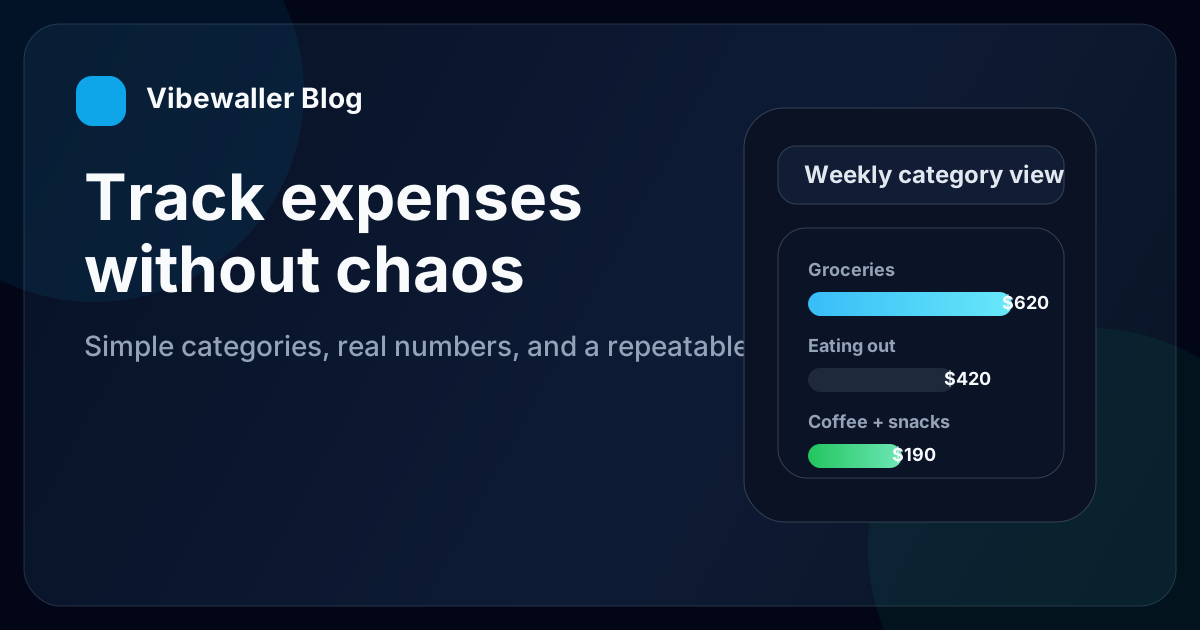
Example 2: A weekly category view
Here is a simple week:
- Groceries: 2,480 UAH
- Eating out: 1,120 UAH
- Transport: 670 UAH
- Coffee and snacks: 540 UAH
- Subscriptions: 239 UAH
- Health: 390 UAH
Total: 5,439 UAH.
This is exactly why category tracking works. Without categories, it just feels like money disappeared. With categories, you can see that groceries were fine, but eating out plus coffee together became 1,660 UAH in one week.
Example 3: Monthly limit logic
Say your food-related plan for the month is:
- groceries: 12,000 UAH
- eating out: 4,000 UAH
- coffee and snacks: 1,500 UAH
Total food budget: 17,500 UAH.
By day 18, your actual numbers are:
- groceries: 8,300 UAH
- eating out: 3,450 UAH
- coffee and snacks: 1,290 UAH
You are not bad with money. You just need an early signal. Groceries are fine, but the convenience layer is already close to the limit.
Common mistakes that make expense tracking fail
1. Tracking only the big expenses
Rent and salary are not enough. The daily layer is where habits live.
2. Creating too many categories too early
If your list has 35 categories in week one, you will slow yourself down and stop entering transactions.
3. Waiting to log later
If you want to know how to track expenses daily, the answer is simple: do it as close to the transaction as possible.
4. Mixing business, personal, and savings flows
If one account handles everything, your review gets noisy.
5. Never reviewing the data
Tracking is only half of personal finance for beginners. The second half is using the information to make better next-week decisions.
What a good monthly review looks like
At month-end, avoid asking vague questions like "Why am I always broke?"
Instead ask:
Where did I overspend?
Look for categories that exceeded your expectation, not just the highest categories overall.
What repeated more often than I thought?
For many people, the issue is not one expensive dinner. It is six ordinary ones.
What deserves a limit next month?
Maybe groceries are stable and transport is predictable, but delivery, snacks, or impulse shopping keeps creeping up.
What can I automate or simplify?
If logging feels annoying, use a system that is easier to maintain.
A practical weekly workflow you can copy
Daily
- record transactions right away
- keep categories simple
- choose the correct asset
Weekly
- check for missed entries
- look at the top 3 categories
- notice unusual days or spikes
Monthly
- compare total spending to income
- set or adjust category limits
- remove one recurring expense that adds little value
That is enough to build clarity without turning money management into a second job.
Conclusion: start simple, then stay consistent
If you are learning how to track expenses, do not begin with an advanced finance system.
Start with one month. Track every outflow. Use a few clean categories. Separate category from asset. Review once a week. Adjust once a month.
That is enough to stop guessing.
If you want a faster way to do it, go back to the main page and see how Finance App turns transactions, assets, and limits into one clear flow. Or start tracking in the app and build the habit while the numbers are still small enough to control.
Better money decisions usually do not begin with more discipline. They begin with better visibility.
Start tracking in a system you will actually keep using
Move from theory to daily clarity with one place for transactions, assets, and category limits.
Start tracking now